Apartment Smoke Detector Test: A Safe Monthly Check
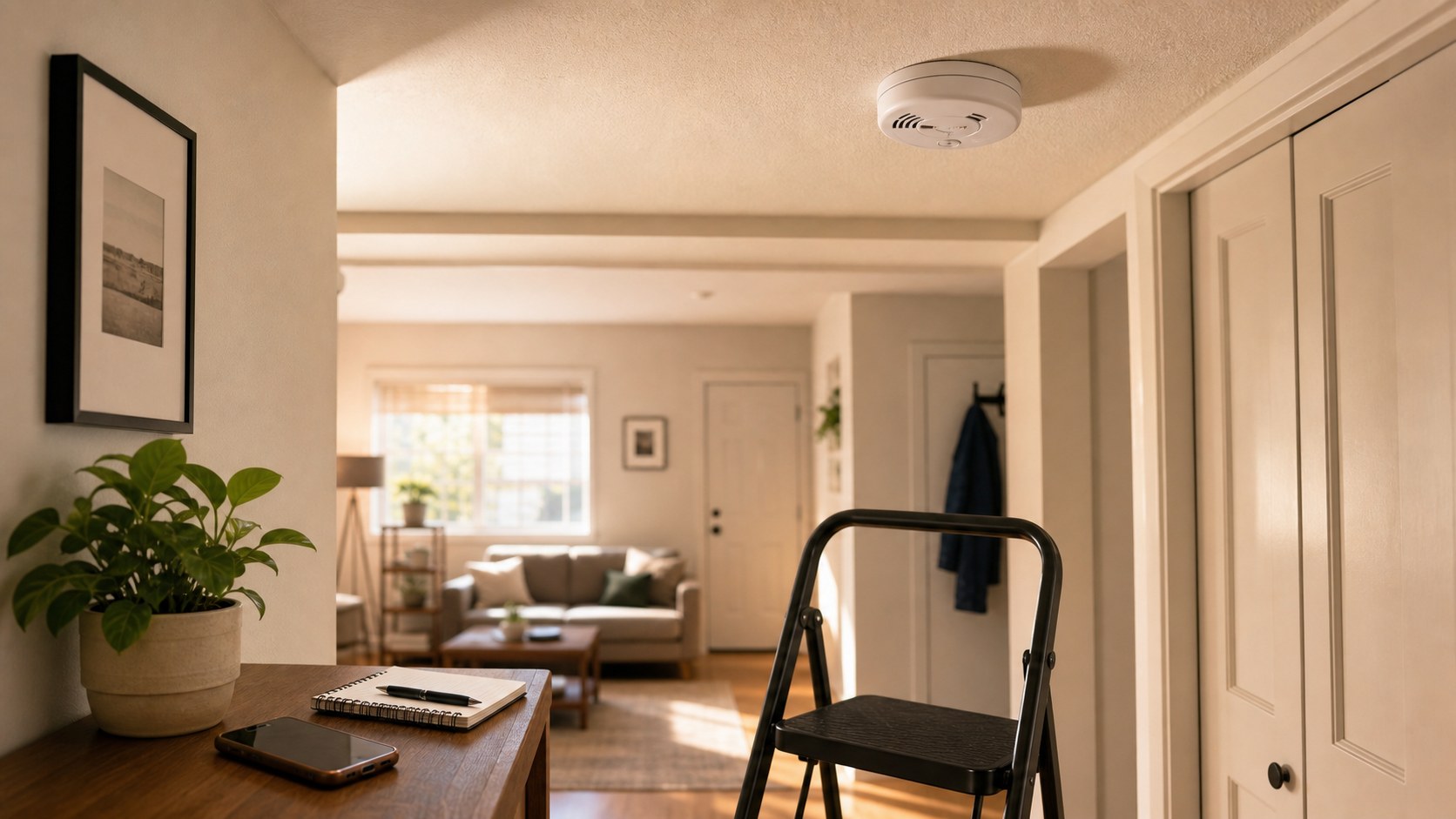
To test a smoke detector in an apartment, use only the built-in test button and keep the alarm installed. Test after move-in, monthly, after a long trip, or when you notice chirping, damage, looseness, heavy paint, or an old-looking unit. This check confirms that the device can sound; it does not verify legal compliance or replace maintenance inspection.
By Portia Me'uan Thomas. Updated August 17, 2026. Edited for renter-aware safety.
Time: 5 minutes. Difficulty: Easy. Safety: Important safety check.
Quick Answer
Warn anyone nearby, stand on a stable surface only if you can reach safely, press and hold the test button until the alarm sounds, release it, and confirm the sound stops. Report a failed test, missing alarm, loose alarm, repeated chirp, damaged cover, or alarm that looks expired to your landlord or maintenance team. Never remove the battery, cover the detector, or take it down to silence it.
Before You Start
- Tell roommates, guests, or nearby neighbors who may hear the test so the sound does not create panic.
- Look for obvious problems first: missing detector, hanging detector, cracked cover, heavy paint, or chirping that has continued for more than a few minutes.
- Use a stable step stool only if you can reach safely with one hand free; do not stand on rolling chairs, boxes, tubs, sinks, or countertops.
- Do not remove the detector from the wall or ceiling, and do not open a hardwired unit.
- If the alarm is connected to a building fire system, follow the property instructions before testing.
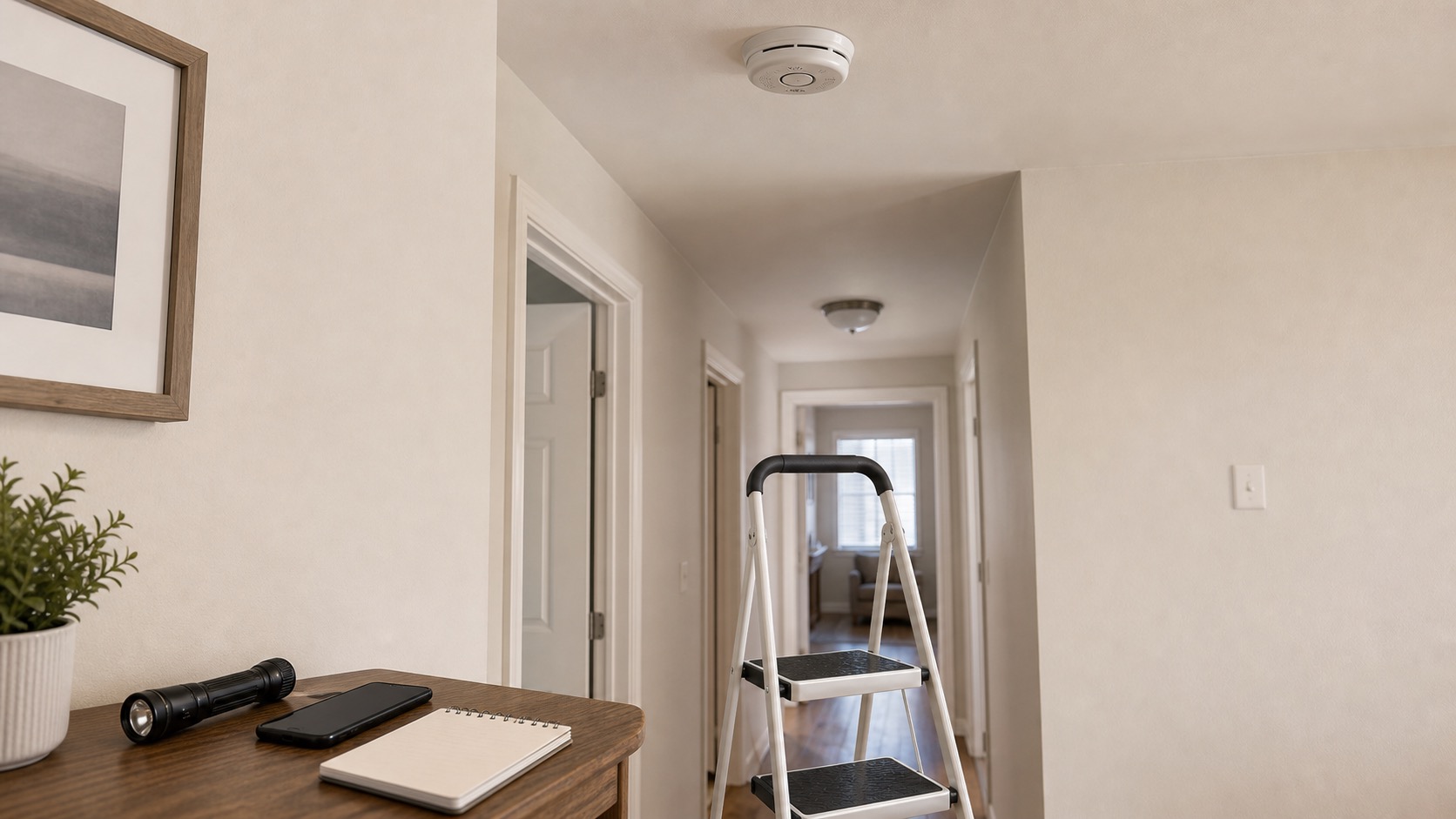
Tools Needed
- Stable step stool if needed
- Phone for maintenance report
- Notes app or notebook
- Fresh battery only if your lease assigns battery replacement to tenants
- Roommate or neighbor warning if the alarm may be loud
Renter Notes
Many landlords are responsible for providing working smoke alarms, and some buildings use hardwired or interconnected systems that tenants should not alter. Your lease or local rules may say whether tenants replace ordinary batteries, but missing alarms, failed tests, repeated chirping, loose wiring, damaged covers, painted detectors, or alarms too high to reach safely should be reported through the official maintenance process. Keep a screenshot or confirmation of the report because alarm issues are safety issues, not cosmetic requests.
Step-by-Step Guide
- Stand where you can reach the test button without stretching or leaning sideways.
What I check before the next step: I treat the result as information. If the problem improves, I verify once; if it stays the same or worsens, I do not keep repeating the step with more force. - Press and hold the test button until the alarm sounds; many alarms need a firm press for several seconds.
What I check before the next step: I stay dry and hands-off with wiring or panels. Smoke, sparks, heat, burning smell, carbon monoxide alarms, repeated trips, or wet electrical areas mean stop immediately. - Release the button and step down before doing anything else.
What I check before the next step: Before continuing, I confirm the step stayed dry, visible, reversible, and within the lease or my comfort level. - Confirm the alarm stops on its own after the test cycle.
What I check before the next step: I stay dry and hands-off with wiring or panels. Smoke, sparks, heat, burning smell, carbon monoxide alarms, repeated trips, or wet electrical areas mean stop immediately. - Listen for chirping, weak sound, no sound, or unusual clicking after the test.
What I check before the next step: I treat the result as information. If the problem improves, I verify once; if it stays the same or worsens, I do not keep repeating the step with more force. - Look at the detector from the floor and note whether it is loose, stained, painted over, cracked, or missing a cover.
What I check before the next step: I make the note useful: date, location, what changed, one wide photo, and one close-up before I touch anything else. - Write down the room, date, and result so you can compare next month.
What I check before the next step: I make the note useful: date, location, what changed, one wide photo, and one close-up before I touch anything else. - If you have more than one detector, test one at a time and record each room separately so a hallway alarm does not make you assume the bedroom alarm also works.
What I check before the next step: I stay dry and hands-off with wiring or panels. Smoke, sparks, heat, burning smell, carbon monoxide alarms, repeated trips, or wet electrical areas mean stop immediately. - Report a failed test, missing detector, loose detector, repeated chirp, or alarm you cannot safely reach.
What I check before the next step: I stay dry and hands-off with wiring or panels. Smoke, sparks, heat, burning smell, carbon monoxide alarms, repeated trips, or wet electrical areas mean stop immediately.
Safe Next Steps
- If the result improved, do one normal-use test and finish with the checklist item: Nearby people warned.
- If the result is mixed, stop after the listed low-risk checks and decide whether the issue belongs with maintenance, your landlord, or a licensed professional.
- If the result did not improve or got worse, do not add force, stronger chemicals, hidden disassembly, or a new tool. Contact maintenance immediately if any stop sign appears.
- For a rental, send a short maintenance message with where the issue is, when you noticed it, what changed, what safe check you tried, and two photos. Keep the confirmation.
Common Mistakes
- Testing with a match, candle, incense, or cooking smoke instead of the test button.
- Removing the battery because chirping is annoying and then forgetting the alarm is disabled.
- Standing on a rolling chair, toilet lid, box stack, or wet bathtub edge to reach the button.
- Assuming a chirp is harmless because the alarm still looks normal.
- Forgetting to report a failed alarm because there is no active emergency at that moment.
How to Test a Smoke Detector Safely
smoke detector test is treated here as a beginner observation and control problem first, not a chance to prove you can take apart the home. The safe version is visible, reversible, and easy to stop.
For renters, the important line is ownership. You can usually observe, photograph, time, clean lightly, or tighten a visible non-security part, but hidden systems, building-owned fixtures, and lease-controlled hardware belong to maintenance.
What to Check Before You Act
This is a schedule and response test. Do not create smoke, open sealed alarms, or climb on unstable furniture.
| Check | Before | After | Interpretation |
|---|---|---|---|
| Location record | Room name/photo | Record detector present? | Missing units are reportable. |
| Test button result | Button pressed from stable position | Record loud/weak/no sound | Weak or no sound fails the check. |
| Chirp check | Silent before test? | Record chirp continues? | Chirps need battery/device/property follow-up. |
| Monthly schedule | No reminder | Record reminder set | Testing is only useful if repeated. |
Common Situations and Stop Points
| Symptom | Possible context | Safe first check | Stop point |
|---|---|---|---|
| No sound on test | Dead battery, failed unit, wiring issue | Report with photo | Do not open hardwired unit |
| Repeated chirp | Low battery or end-of-life | Check lease instructions | Report if continues |
| Unreachable alarm | High ceiling/location | Request maintenance test | No unsafe climbing |
| Real alarm sounding | Smoke/fire/CO depending alarm type | Treat as real | Emergency response |
Try It or Report It?
| Situation | Beginner can try | Do not touch | Contact |
|---|---|---|---|
| Accessible test button | Warn people and press button | Internal wiring | Report failure |
| Battery chirp | Follow property instructions | Disable alarm | Maintenance if unresolved |
| Hardwired alarm | Use test button only | Disconnect wires | Maintenance |
| Real smoke or CO concern | Leave if safe | Diagnosis | Emergency services |
Renter-Safe First Steps
- Press the test button.
- Use stable footing.
- Record each room.
- Report failed or missing units.
Stop Lines
- Stop if you cannot reach safely.
- Stop if the unit is hardwired and needs opening.
- Stop for weak/no sound.
- Stop for real smoke or CO alarm.
- Stop before covering or disabling an alarm.
Additional FAQ
What if the smoke detector test button does not work?
Treat no sound or a weak sound as a failed check. Keep the alarm installed, photograph its room and condition, and contact maintenance promptly.
How often should I test?
Monthly is a practical habit, and always after move-in.
Can I remove it while cooking?
No. Ventilate and use fans, but keep alarms installed.
What if it is painted over?
Photograph it and report it. Paint can interfere with proper function.
Related Next Steps
- Power Outage Alone: A Calm Apartment Safety Plan - Outage and emergency safety planning.
- First Apartment Maintenance Checklist - Add alarm testing to the monthly routine.
- Basic Emergency Kit for Living Alone - Pair alarms with light, power, and contacts.
What Not to Do
- Do not cover, paint, remove, unplug, or disable a smoke detector.
- Do not test with real smoke or open flame.
- Do not ignore a detector that fails to sound, sounds weak, chirps repeatedly, or hangs loose.
- Do not replace a hardwired detector, building alarm, or ceiling-mounted unit unless maintenance specifically instructs you and it is allowed.
- Do not climb unsafely to reach a detector; ask maintenance to test it instead.
When to Pause and Ask for Help
Contact maintenance immediately if the detector is missing, loose, damaged, expired, painted over, chirping repeatedly, too high to reach safely, or fails the test. If your building uses interconnected alarms, ask the property team how testing should be handled. Call emergency services if an alarm sounds and you see smoke, smell burning, feel heat, hear a carbon monoxide alarm, or feel unsafe.
FAQ
How often should I test a smoke detector in an apartment?
Test each alarm monthly, after moving in, and after any battery replacement or maintenance work, unless your building provides different instructions for an interconnected system.
What if I cannot reach it?
Ask maintenance to test it rather than climbing unsafely. A detector that requires unsafe access is still a maintenance issue.
What does chirping mean?
It often means a low battery, end-of-life warning, loose battery drawer, or device problem. Check your lease and report it if it continues.
Can I take it down while cooking?
No. Ventilate the kitchen, use an exhaust fan if available, and keep the detector installed.
What if the alarm is hardwired?
Do not disconnect it. Use the test button if it is safe and allowed, and contact maintenance for battery backup, replacement, or wiring issues.
What if it sounds but seems quiet?
Treat weak sound as a problem. Note the room and report it so maintenance can inspect or replace the detector.
Final Checklist
- Nearby people warned
- Stable reach confirmed
- Test button pressed
- Alarm sounded clearly
- No detector disabled
- Chirping checked
- Maintenance contacted if test failed
References
Use these official resources as background context. Product manuals, lease rules, local requirements, property maintenance instructions, and qualified professional advice should still come first for your exact home.
- Smoke alarms - U.S. Fire Administration. Use the test button and follow manufacturer or property instructions for alarms in your unit.
- Smoke Alarms in U.S. Home Fires - National Fire Protection Association. Use as report-level background for why missing, disabled, painted, or failed alarms should be treated as safety issues.
You May Also Like
More beginner-safe guides that connect to this repair, the same room, or the next safety decision a renter may need.
- First Apartment Maintenance Checklist - A realistic monthly checklist for keeping a first apartment safer and easier to manage.
- Power Outage Alone: A Calm Apartment Safety Plan - A calm power outage plan for people living alone, with clear electrical safety boundaries.
- When Not to DIY a Home Repair - Clear stop signs for repairs that are unsafe, lease-sensitive, or require licensed help.
- Rental Light Bulb Replacement: The Safe Version - Replace a standard apartment light bulb safely, with clear stop points for fixtures and wiring.
- Tripped Circuit Breaker: A Safe Reset Checklist - Reset a clearly labeled tripped breaker only when conditions are dry, safe, and renter-appropriate.
- Basic Emergency Kit for Living Alone - Build a practical emergency kit for outages, storms, minor injuries, and apartment disruptions.
- Safe to DIY? A Renter's Home Repair Filter - Use a simple safety filter before deciding whether to DIY a repair in your first place.
- Small Water Leak: What to Do While Waiting for Maintenance - Contain a small apartment water leak while waiting for maintenance, document the damage, avoid electrical danger, and know when to escalate.