Drafty Apartment Window: Renter-Safe First Fixes
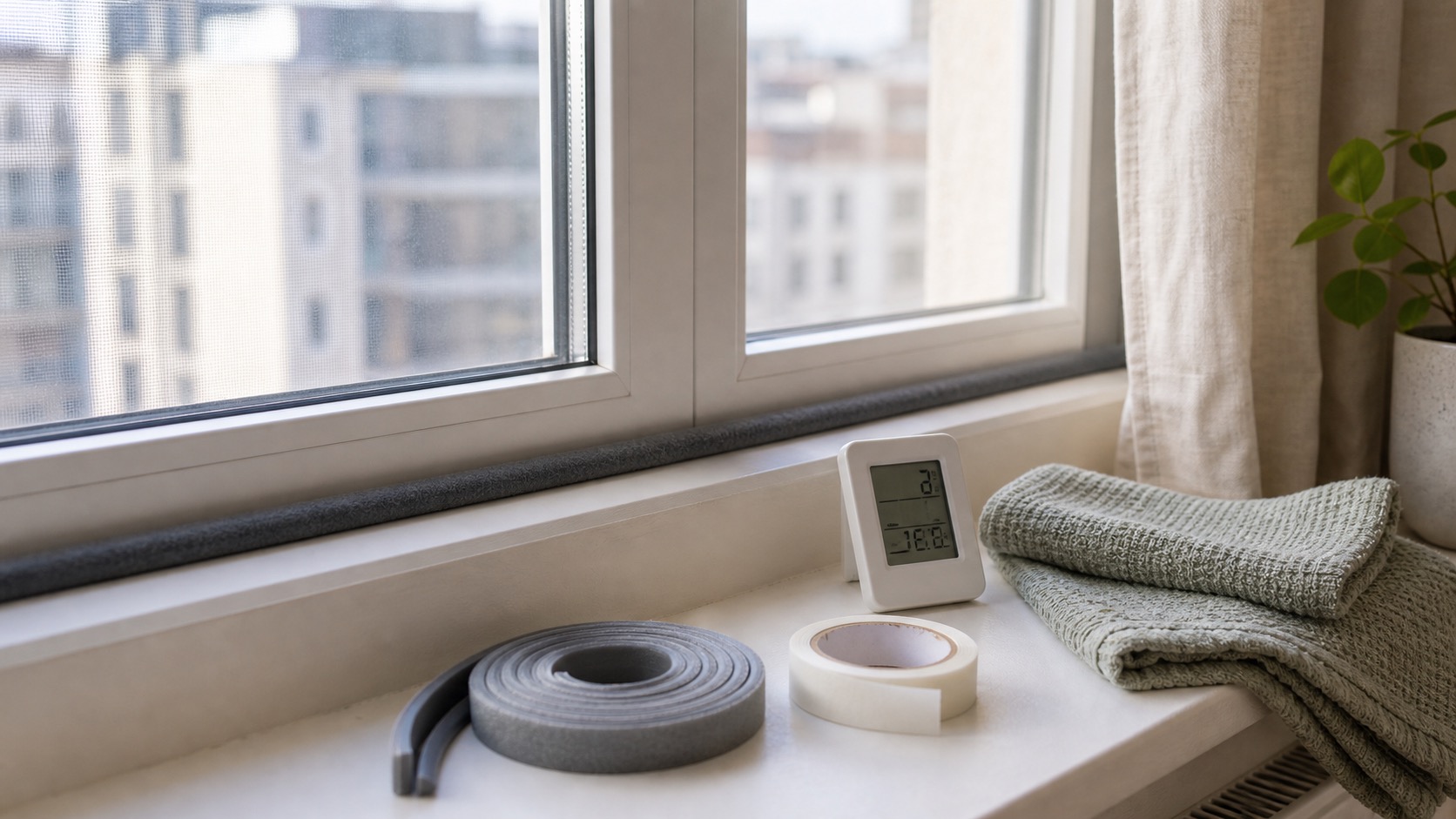
Use this when you feel cold air around a closed apartment window, especially near the sash, sill, or edges during winter. This guide covers temporary draft reduction, not window replacement, broken glass, or damaged frames.
By Portia Me'uan Thomas. Updated August 17, 2026. Edited for renter-aware safety.
Time: 20-45 minutes. Difficulty: Easy. Safety: Low.
Quick Answer
Lock the window fully, clean the frame, find the draft with your hand, add removable weatherstripping or a draft stopper where allowed, and document damaged seals or broken locks for maintenance. Do not caulk, paint, drill, or seal an emergency egress window shut.
Material Fit
Hardware and setup tasks depend on what the screw or load is biting into. When the material is unknown, I stop before drilling or anchoring.
| Material or surface | Safest first method | Conditional next method | Avoid / stop line |
|---|---|---|---|
| Solid wood or sturdy cabinet face | Hand-tighten visible screws a quarter-turn at a time. | Use normal-use testing before adding load. | Stop for splitting, spinning screws, or shifting alignment. |
| Particleboard / MDF furniture | Gentle cam-lock or screw adjustment only. | Unload shelves before testing. | Avoid over-tightening; it can crumble the material. |
| Drywall or plaster wall | Use removable or approved methods first. | Anchors only with landlord approval and correct hardware. | Stop if the wall crumbles, flexes, or hides utilities. |
| Tile, brick, metal frame, entry door | Document and request approval or maintenance. | Professional installation may be needed. | Do not drill or modify without written permission. |
Before You Start
- Confirm the window closes and locks before adding anything.
- Check your lease before applying adhesive weatherstripping or window film.
- Make sure you do not block a required exit window or fire escape access.
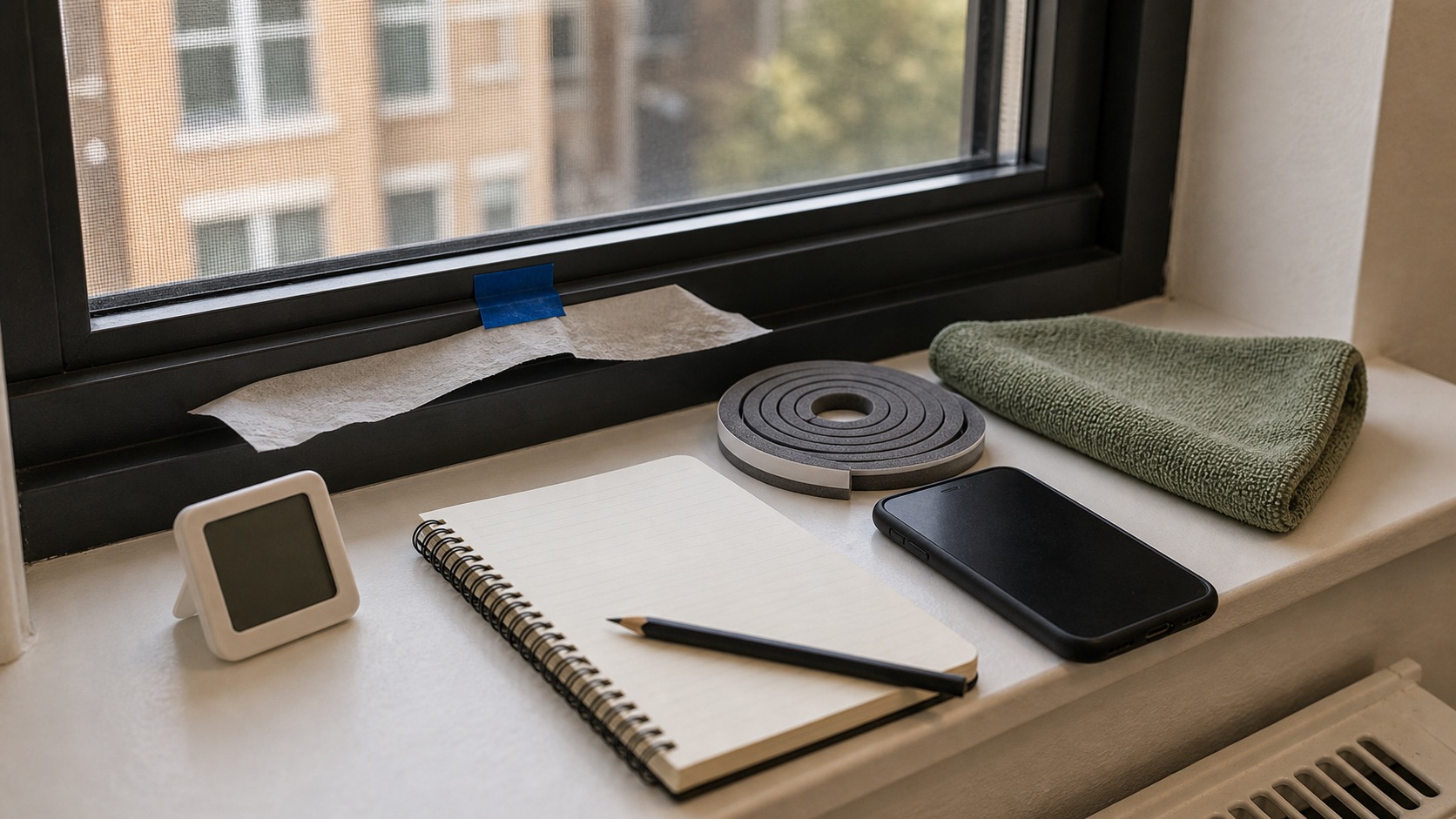
Tools Needed
- Microfiber cloth
- Mild cleaner
- Removable foam weatherstripping if allowed
- Draft stopper or rolled towel
- Painter's tape
- Phone camera
Renter Notes
Removable draft control is usually safer for renters than permanent caulk or hardware. Report broken locks, cracked glass, rotted frames, heavy condensation, or windows that will not open and close safely.
Step-by-Step Guide
- Close and lock the window, then check whether the draft improves.
What I check before the next step: I keep the door or window from trapping me while testing. Entry locks, broken latches, cracked frames, or security uncertainty belong with maintenance or a locksmith. - Wipe dust from the sill, tracks, and frame so removable products can sit flat.
What I check before the next step: I do not mix chemicals or scrub harder if the finish changes. I ventilate, spot-check, and stop for strong odor, spreading stains, mold growth, or damaged surfaces. - Move your hand slowly around the edges to locate the strongest draft.
What I check before the next step: Before continuing, I confirm the step stayed dry, visible, reversible, and within the lease or my comfort level. - Place a draft stopper or rolled towel along the sill if the draft comes from the bottom.
What I check before the next step: Before continuing, I confirm the step stayed dry, visible, reversible, and within the lease or my comfort level. - Apply removable foam weatherstripping only where it will not prevent the window from locking or opening.
What I check before the next step: I keep the door or window from trapping me while testing. Entry locks, broken latches, cracked frames, or security uncertainty belong with maintenance or a locksmith. - Take photos and submit a maintenance request if the lock, glass, seal, or frame appears damaged.
What I check before the next step: I make the note useful: date, location, what changed, one wide photo, and one close-up before I touch anything else.
Safe Next Steps
- If the result improved, do one normal-use test and finish with the checklist item: Window closed and locked.
- If the result is mixed, stop after the listed low-risk checks and decide whether the issue belongs with maintenance, your landlord, or a licensed professional.
- If the result did not improve or got worse, do not add force, stronger chemicals, hidden disassembly, or a new tool. Contact your landlord or maintenance team if any stop sign appears.
- For a rental, send a short maintenance message with where the issue is, when you noticed it, what changed, what safe check you tried, and two photos. Keep the confirmation.
Common Mistakes
- Adding thick foam that keeps the window from latching.
- Using permanent caulk on rental windows without permission.
- Ignoring a draft caused by a broken lock or cracked glass.
Window draft location and reversible sealing
a draft around an apartment window is treated here as a beginner observation and control problem first, not a chance to prove you can take apart the home. The safe version is visible, reversible, and easy to stop.
For renters, the important line is ownership. You can usually observe, photograph, time, clean lightly, or tighten a visible non-security part, but hidden systems, building-owned fixtures, and lease-controlled hardware belong to maintenance.
What to Check Before You Act
Record the starting condition, perform only one low-risk check at a time, and compare draft location, window operation, gap and surface, after-treatment airflow. Do not repeat a step that needs more force, chemical, height, access, or disassembly.
| Check | Before | After | Interpretation |
|---|---|---|---|
| Draft location | Record sash edge, meeting rail, frame joint, sill, or nearby outlet | After one safe check: use a tissue or the back of a dry hand | A precise location guides a smaller reversible treatment Stop if testing would involve flame, smoke, electricity, or exterior access. |
| Window operation | Record closing, locking, alignment, screen, and egress function | After one safe check: open, close, and lock once without force | Normal operation is required before adding a seal Stop if glass, lock, frame, or egress is damaged. |
| Gap and surface | Record gap width, surface material, paint condition, and moisture | After one safe check: measure and test product compatibility in a small area | Product type must match the moving or fixed surface Stop if paint lifts, condensation persists, or material is soft. |
| After-treatment airflow | Record same tissue movement and window function | After one safe check: repeat the original check after removable treatment | Less movement with full safe operation is the target Stop if the window sticks, drainage is blocked, or condensation increases. |
Common Situations and Stop Points
| Symptom | Possible context | Safe first check | Stop point |
|---|---|---|---|
| Draft location | A precise location guides a smaller reversible treatment | use a tissue or the back of a dry hand | testing would involve flame, smoke, electricity, or exterior access |
| Window operation | Normal operation is required before adding a seal | open, close, and lock once without force | glass, lock, frame, or egress is damaged |
| Gap and surface | Product type must match the moving or fixed surface | measure and test product compatibility in a small area | paint lifts, condensation persists, or material is soft |
| After-treatment airflow | Less movement with full safe operation is the target | repeat the original check after removable treatment | the window sticks, drainage is blocked, or condensation increases |
Try It or Report It?
| Situation | Beginner can try | Do not touch | Contact |
|---|---|---|---|
| Observe and document | Locate the draft without flame or smoke. Confirm the window closes, locks, drains, and serves as required. | Hidden, fixed, energized, pressurized, structural, or lease-controlled parts | Use the record if the baseline is abnormal |
| One reversible first step | Measure the gap and test a lease-approved removable product. Recheck airflow and full operation afterward. | Anything that needs force, drilling, cutting, panel removal, or mixed chemicals | Maintenance if the first step fails or the condition returns |
| Condition persists | Repeat the observation for draft location and window operation, not the repair | Do not escalate tools or improvise a workaround | Landlord, maintenance, manufacturer support, or the responsible professional |
| Warning sign appears | Stop, keep distance, and photograph only if that is safe | Stop for cracked glass, failed locks, frame damage, or unsafe egress. Stop for active water, recurring condensation, mold-like growth, or soft material. Stop before caulk, spray foam, drilling, or permanent film without approval. | Urgent maintenance, utility, emergency services, or another appropriate safety channel |
Renter-Safe First Steps
- Locate the draft without flame or smoke.
- Confirm the window closes, locks, drains, and serves as required.
- Measure the gap and test a lease-approved removable product.
- Recheck airflow and full operation afterward.
Stop Lines
- Stop for cracked glass, failed locks, frame damage, or unsafe egress.
- Stop for active water, recurring condensation, mold-like growth, or soft material.
- Stop before caulk, spray foam, drilling, or permanent film without approval.
- Stop if a product blocks drainage or window operation.
- Stop before exterior or ladder work.
Additional FAQ
Can I use a candle to find the draft?
No. Use a tissue or another flameless method away from electrical hazards.
Should I caulk the moving parts?
No. Weatherstripping is generally for moving joints; permanent caulk and frame work require owner approval and correct placement.
What should I include in a maintenance message?
Include the exact location, when it started, photos, the draft location and window operation and gap and surface and after-treatment airflow, what safe check you performed, and whether the condition improved, stayed the same, or worsened.
Related Next Steps
- Curtains in a Rental: Hang Them Without Wall Damage - Add curtains without blocking safe window operation.
- Bathroom Mold Spots: Clean, Document, or Report? - Use moisture boundaries if condensation has caused growth.
- Heat or AC Stopped in an Apartment: Safe First Moves - Separate a local draft from a broader heating problem.
What Not to Do
- Do not seal a window shut, especially if it may be an emergency exit.
- Do not drill into window frames or install permanent hardware without approval.
- Do not cover moisture, mold, or rot with tape and call it fixed.
When to Pause and Ask for Help
Contact your landlord or maintenance team if the window will not lock, glass is cracked, the frame is soft or rotted, water enters, condensation is heavy between panes, or the window cannot open for emergency exit.
FAQ
Is removable weatherstripping okay in a rental?
Often, but check your lease and test carefully. Adhesive products can still pull paint or finish.
Can I use plastic window film?
Possibly, if your lease allows it and the window is not needed for emergency exit. Remove it carefully at move-out.
Why is my locked window still drafty?
Old seals, warped sashes, loose locks, or frame gaps can leak air even when locked.
Should maintenance fix drafts?
They should address damaged locks, glass, frames, or seals. Temporary comfort steps are different from window repair.
Final Checklist
- Window closed and locked
- Draft location found
- Frame cleaned
- Removable solution used
- Exit access kept clear
- Damage photographed and reported
References
Use these official resources as background context. Product manuals, lease rules, local requirements, property maintenance instructions, and qualified professional advice should still come first for your exact home.
- Insulation and air-sealing essentials - U.S. Department of Energy. Use for understanding drafts and simple air-leak checks before adding renter-safe weatherproofing.
- Consumer guide to air sealing the home - U.S. Department of Energy. Use as background for temporary weatherstripping choices; renters should avoid permanent changes without approval.
You May Also Like
More beginner-safe guides that connect to this repair, the same room, or the next safety decision a renter may need.
- Curtains in a Rental: Hang Them Without Wall Damage - Add privacy with renter-friendly curtain options that avoid drilling and wall damage.
- First Apartment Maintenance Checklist - A realistic monthly checklist for keeping a first apartment safer and easier to manage.
- Front Door Security Check for Renters - Improve front-door confidence with renter-safe checks, habits, and clear lock repair boundaries.
- Safe to DIY? A Renter's Home Repair Filter - Use a simple safety filter before deciding whether to DIY a repair in your first place.
- Heat or AC Stopped in an Apartment: Safe First Moves - Handle apartment heat or AC problems safely while you document the issue and contact maintenance.
- HVAC Air Filter First Check: What Renters Can Safely Do - Check and clean a reusable HVAC filter only when your rental system and lease allow it.
- Basic Emergency Kit for Living Alone - Build a practical emergency kit for outages, storms, minor injuries, and apartment disruptions.
- When Not to DIY a Home Repair - Clear stop signs for repairs that are unsafe, lease-sensitive, or require licensed help.